
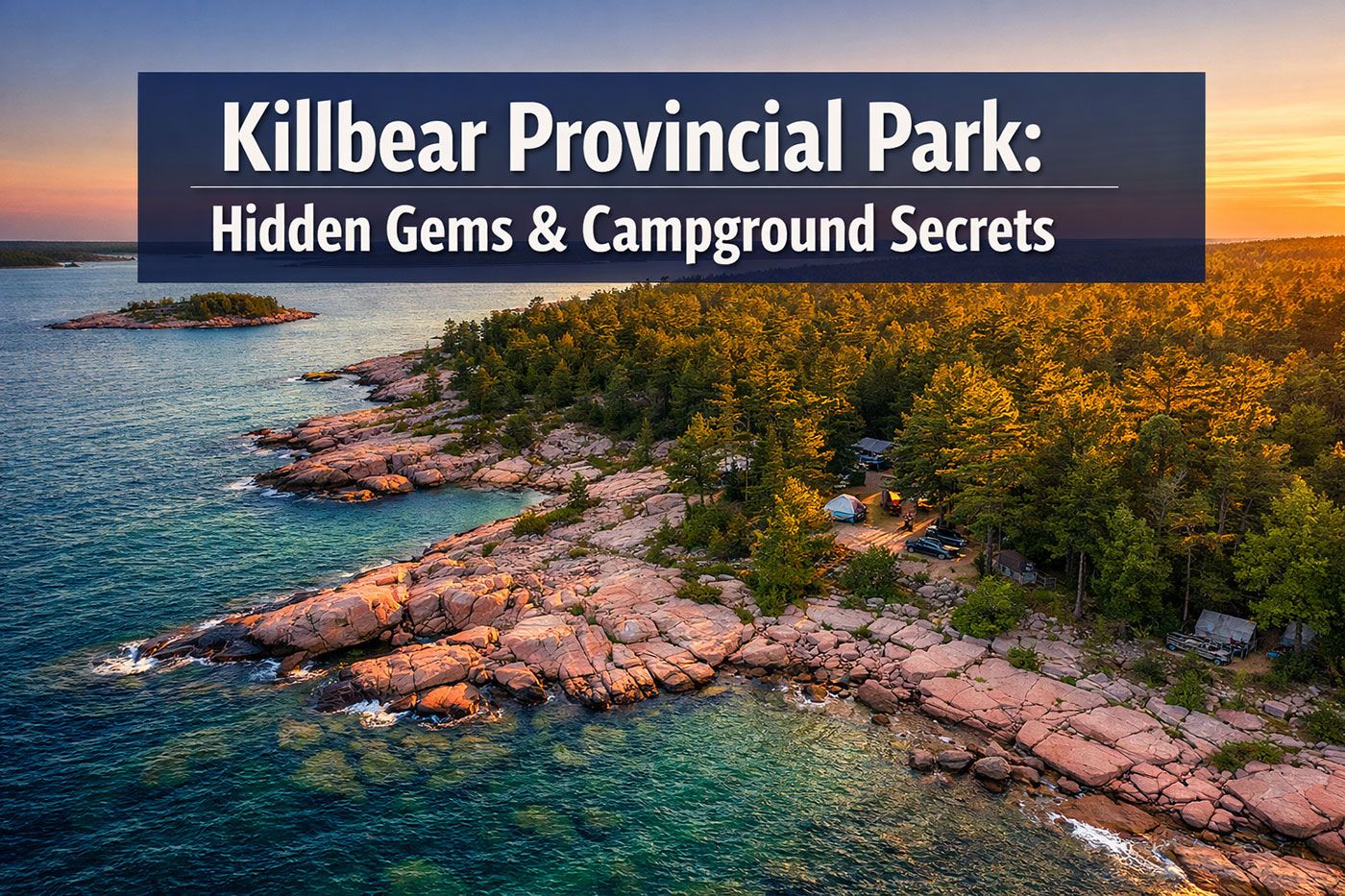
Killbear Provincial Park, located on Georgian Bay near Parry Sound, Ontario, offers 883 campsites across six loops, but the true hidden gems include secluded interior sites on the Canadian Shield, quiet early-season camping periods, and lesser-known natural features like the Lighthouse Point trail and pitcher plant wetlands. Beyond the popular waterfront sites, campers who explore the park’s backcountry trails, off-peak timing, and ecological treasures will discover a richer, more peaceful camping experience.
Key Takeaways
- Six distinct camping loops offer different experiences, from busy family-friendly areas to quiet, secluded interior sites on granite bedrock
- Lighthouse Point and Twin Points provide the best hidden trails for sunset views and wildlife observation away from crowds
- Early June and post-Labour Day are ideal times to access premium sites without the summer rush
- Interior non-electric sites (numbers 701-883) offer true backcountry atmosphere while remaining car-accessible
- Pitcher plant wetlands and rare Carolinian species make Killbear a biodiversity hotspot often overlooked by casual visitors
- Georgian Bay’s pink granite shoreline creates unique camping opportunities on Canadian Shield bedrock
- Advance booking strategies focusing on midweek arrivals and shoulder seasons dramatically improve site selection
- Hidden canoe launches at Kilcoursie Bay and Harold Point offer calm-water paddling away from main beach areas
What Makes Killbear Provincial Park Different from Other Ontario Campgrounds?
Killbear Provincial Park stands apart because it combines Georgian Bay’s dramatic pink granite landscape with accessible car camping and genuine wilderness character. The park sits on a peninsula jutting into Georgian Bay, meaning water surrounds campers on three sides and creates microclimates and ecosystems not found inland.
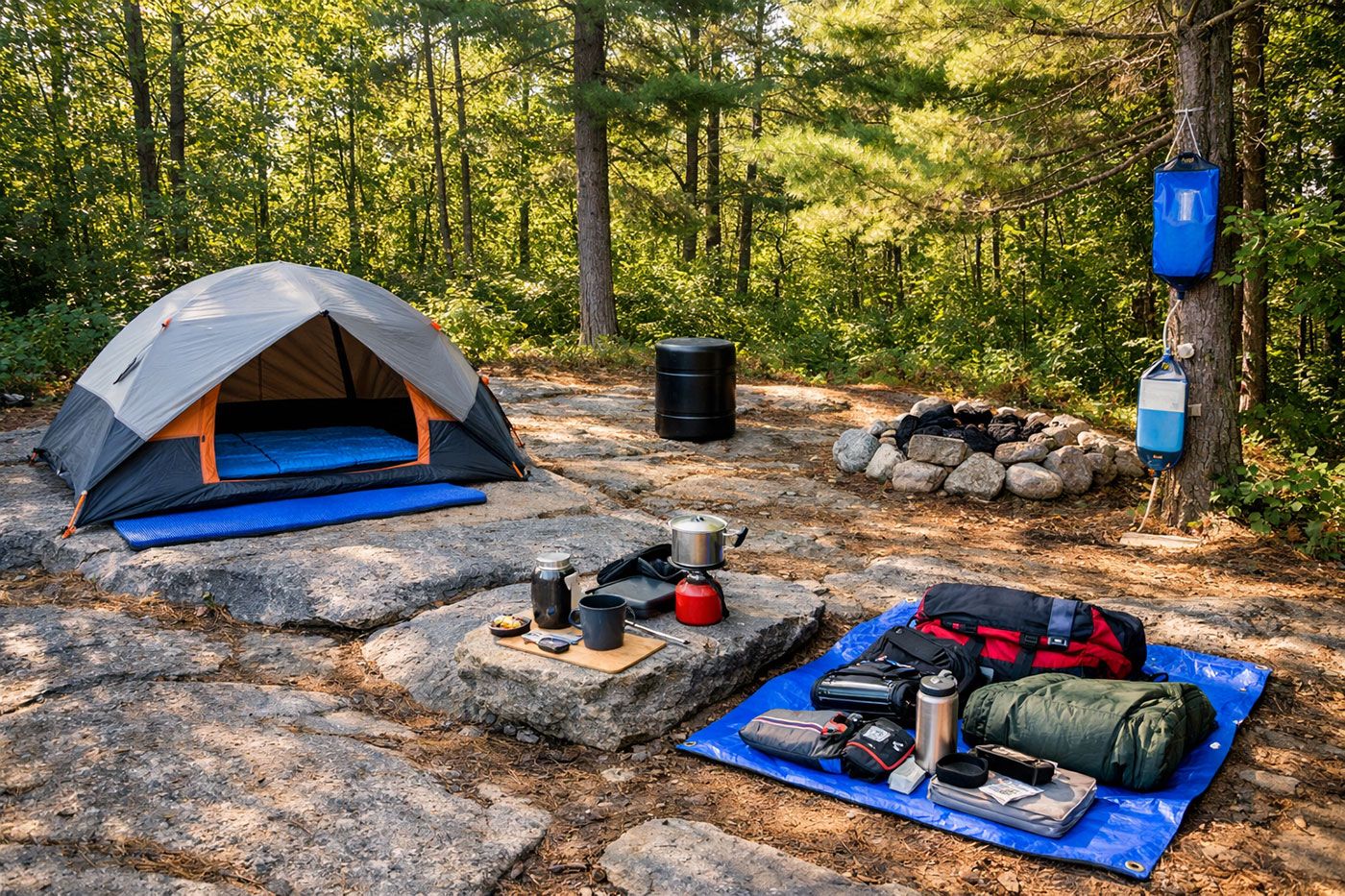
The Canadian Shield bedrock defines the camping experience here. Instead of grassy tent pads, many sites feature flat granite surfaces where campers pitch tents directly on rock (with foam padding recommended). This geological feature creates natural privacy between sites and prevents the worn, muddy conditions common at heavily used campgrounds.
What sets Killbear apart:
- 883 campsites spread across varied terrain, from waterfront to deep forest interior
- 33 kilometers of hiking trails including coastal routes and interior forest loops
- Georgian Bay archipelago access for experienced paddlers exploring the Thirty Thousand Islands
- Rare ecological transition zone where northern boreal forest meets southern Carolinian species
- Multiple beach areas with different characteristics (sandy, rocky, sheltered, wave-exposed)
Choose Killbear if you want established campground amenities (flush toilets, showers, comfort stations) combined with rugged natural beauty and opportunities for solitude. Avoid it if you need guaranteed electrical hookups at every site or prefer flat, grassy camping areas.
Which Killbear Provincial Park Campsites Are the True Hidden Gems?
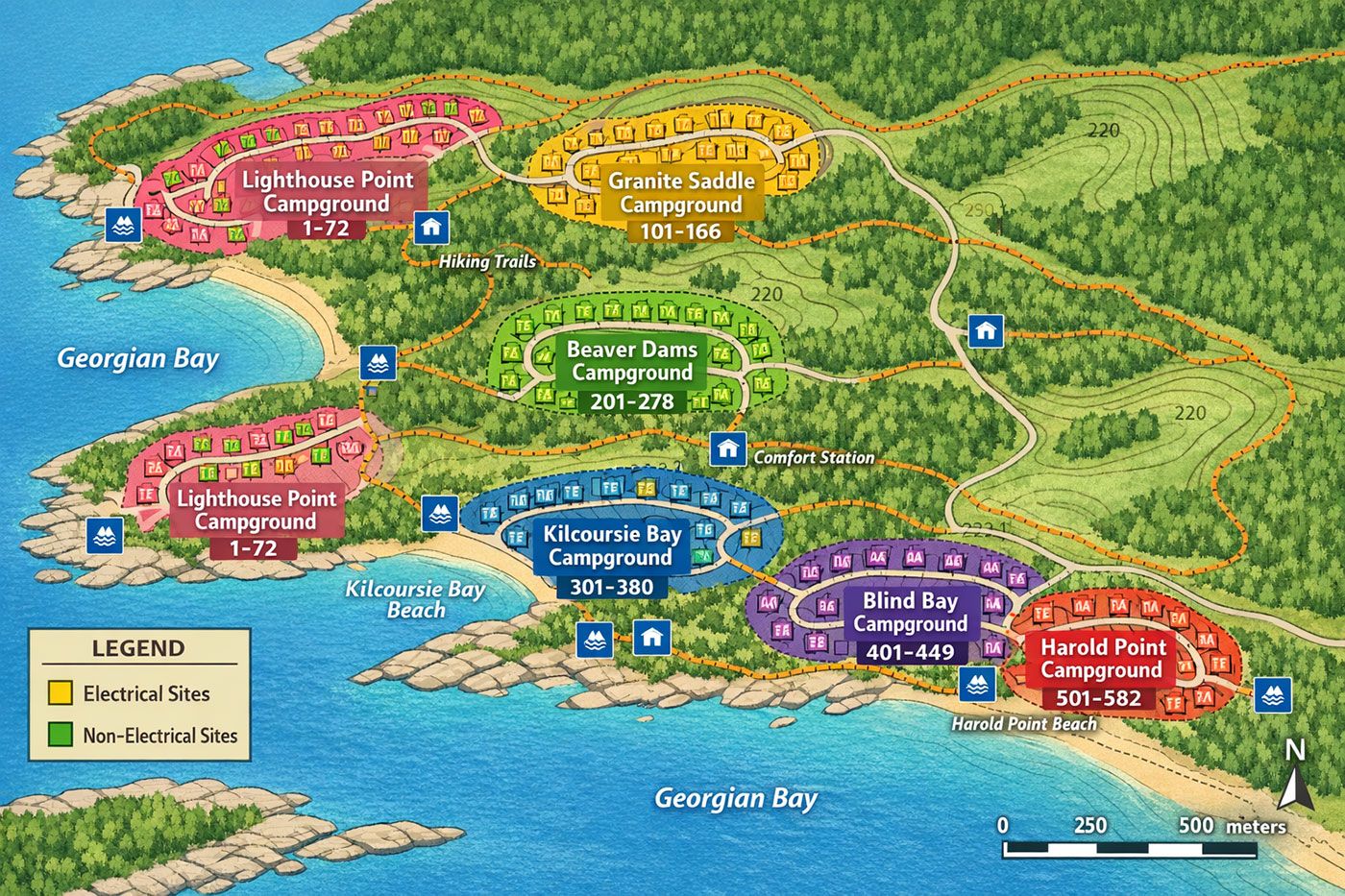
The best hidden gem sites at Killbear Provincial Park are the interior non-electric sites numbered 701-883 in the Kilcoursie Bay and Harold Point areas, plus select sites on the outer edges of Lighthouse Point loop. These locations offer privacy, natural surroundings, and proximity to trails while avoiding the congestion of waterfront loops.
Top hidden gem site categories:
Interior forest sites (701-883):
- Surrounded by mature white pine and mixed hardwood forest
- Granite bedrock camping with natural sound barriers between sites
- Closer to interior hiking trails and wetland observation areas
- Significantly quieter than waterfront locations
- Often available when waterfront books solid months in advance
Outer Lighthouse Point sites (select numbers):
- Access to the best sunset viewing location in the park
- Walking distance to Lighthouse Point trail and Georgian Bay overlooks
- More spacing between sites compared to inner loop
- Natural rock formations create privacy screens
Harold Point perimeter sites:
- Backs onto undeveloped forest buffer zones
- Short walk to secluded canoe launch at Harold Point
- Less traffic noise from internal campground roads
- Ideal for tent campers seeking backcountry atmosphere with car access
Common mistake: Booking waterfront sites assuming they’re automatically better. Many waterfront locations have thin vegetation buffers, close neighbors, and constant foot traffic from beach-goers walking past campsites. Interior sites often provide more genuine solitude.
Booking strategy: Search for sites with “no services” or “non-electric” filters during reservation. These sites cost less and attract fewer RV campers, increasing availability and reducing generator noise.
When Should You Visit Killbear Provincial Park to Avoid Crowds?
Visit Killbear Provincial Park during the first two weeks of June or from the Tuesday after Labour Day through mid-October to experience the park with 40-60% fewer campers while still enjoying good weather. These shoulder seasons offer the best balance of site availability, comfortable temperatures, and access to park amenities.
Optimal timing windows:
Early June (opens around first weekend):
- Water temperature still cold (12-15°C) but air temperatures pleasant (18-24°C)
- Black flies largely finished by second week of June in this region
- All facilities open and fully staffed
- Wildflowers blooming along trails
- Significantly easier to book premium sites even one week in advance
September (post-Labour Day through month-end):
- Water retains summer warmth (16-19°C) for comfortable swimming
- Fall colors begin appearing in hardwood sections
- Reduced campground noise and traffic
- Most facilities remain open (some may reduce hours)
- Wildlife more active and visible during cooler temperatures
Early October (until Thanksgiving weekend):
- Peak fall colors across the park
- Crisp temperatures ideal for hiking (10-16°C daytime)
- Campground operating on reduced schedule but still accessible
- Excellent photography conditions with autumn light
- Minimal crowds except Thanksgiving weekend itself
Avoid if possible:
- Late July through mid-August: Peak season with maximum occupancy, advance booking required 5-6 months ahead
- Long weekends (Victoria Day, Canada Day, Civic Holiday, Labour Day): Campground at capacity with day-use areas congested
- Late May: Black fly season can be intense, water still very cold
Weekday advantage: Arriving Tuesday or Wednesday (even during summer) means quieter campground atmosphere as weekend campers depart Monday and new arrivals don’t appear until Thursday evening.
What Are the Best Hidden Trails and Natural Features at Killbear Provincial Park?
The Lighthouse Point Trail and Twin Points Trail represent Killbear’s best-kept secrets, offering dramatic Georgian Bay vistas, wildlife habitat, and solitude that most visitors miss while staying near beaches. These trails showcase the park’s ecological diversity and geological features beyond the campground experience.
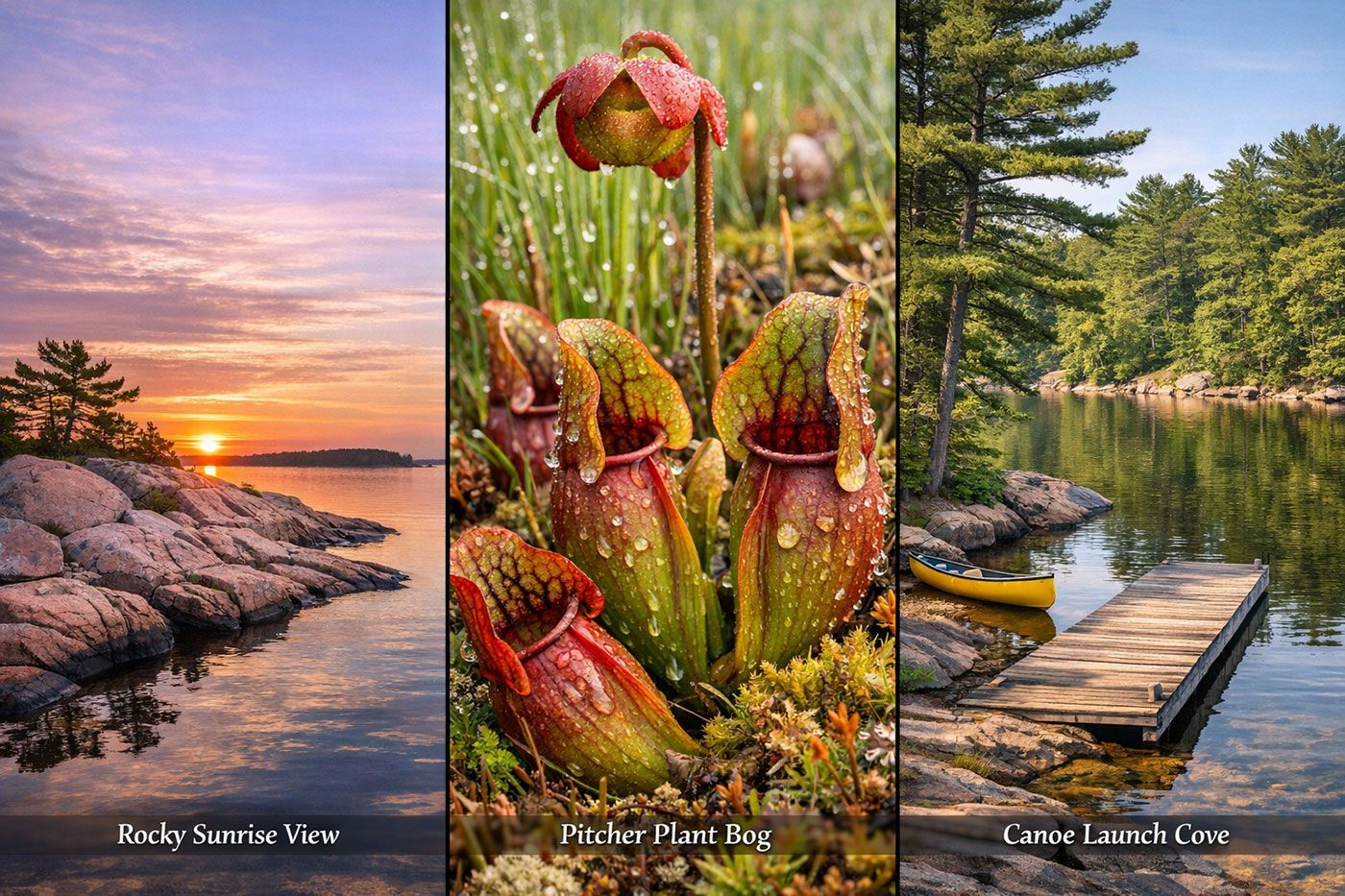
Lighthouse Point Trail (2.8 km loop):
- Starts near Lighthouse Point campground but sees minimal traffic
- Traverses exposed granite headlands with 180-degree Georgian Bay views
- Best sunset location in entire park (arrive 45 minutes before sunset)
- Watch for nesting osprey and bald eagles along shoreline cliffs
- Blueberry bushes abundant in late July and August
- Bring headlamp if hiking for sunset (trail becomes dark quickly)
Twin Points Trail (3.2 km):
- Accesses quiet northeastern section of park peninsula
- Passes through rare pitcher plant bog (carnivorous plant habitat)
- Two distinct rocky points extending into Georgian Bay
- Excellent for wildlife observation (deer, fox, various bird species)
- Less maintained than main trails, requires proper footwear
- Connects to interior forest sections with old-growth white pine
Pitcher plant wetlands:
- Located along Twin Points Trail and near site cluster 800s
- Best viewing June through August when plants actively trap insects
- Represents rare habitat type for southern Georgian Bay region
- Bring macro camera lens for detailed plant photography
Pink granite formations:
- Precambrian Shield bedrock (1+ billion years old) visible throughout
- Best examples at Lighthouse Point and along Kilcoursie Bay shoreline
- Creates natural tide pools with unique microhabitats
- Ideal for geology enthusiasts and educational opportunities with children
Carolinian forest pockets:
- Southern tree species (red oak, black cherry) at northern range limit
- Found in sheltered valleys within park interior
- Demonstrates climate transition zone characteristics
- Compare with northern boreal species (white pine, balsam fir) on exposed ridges
Common mistake: Spending entire visit at the main beach and campground without exploring trail systems. The beach represents less than 5% of park’s natural features.
How Can Tent Campers Maximize Comfort on Killbear’s Granite Campsites?
Tent campers should bring closed-cell foam pads or extra sleeping pad layers when camping on Killbear Provincial Park’s granite sites, as standard air mattresses alone provide insufficient insulation and comfort on rock surfaces. Proper site preparation and gear selection transform challenging bedrock camping into a comfortable experience.
Essential gear for granite camping:
Ground insulation layers (bottom to top):
- Reflective emergency blanket or tarp (moisture barrier against rock)
- Closed-cell foam pad (10-15mm thick) (primary insulation and cushioning)
- Self-inflating sleeping pad or air mattress (comfort layer)
- Regular sleeping bag (appropriate for season)
Site setup strategies:
- Scout your site thoroughly: Walk entire area to identify flattest granite sections before unloading gear
- Use tent footprint: Protects tent floor from abrasion on rough rock surfaces (granite can puncture thin tent floors)
- Position tent to avoid water channels: Rain flows along natural rock contours; identify and avoid these drainage paths
- Secure tent with rock anchors: Standard stakes won’t penetrate granite; use heavy rocks on guy lines or specialized rock anchors
- Create kitchen area on flat rock: Natural granite “countertop” provides excellent food prep surface (clean thoroughly first)
Comfort optimization tips:
- Bring extra foam padding for sitting areas around camp (granite gets cold and hard quickly)
- Pack camp chairs with good cushioning rather than relying on sitting on rocks
- Use headlamps and lanterns strategically as granite reflects light well (fewer light sources needed)
- Store gear in waterproof containers as granite sites often have limited natural drainage
Edge case: During rainy periods, some granite sites develop surface water pooling. Bring small squeegee or absorbent towels to manage water around tent perimeter. Position tent on slight elevation if possible.
What to avoid: Don’t attempt to drive tent stakes into rock crevices filled with soil; these often contain tree roots or are too shallow for secure anchoring.
What Wildlife and Ecological Treasures Should Campers Look For?
Killbear Provincial Park hosts over 200 bird species, black bears, eastern Massasauga rattlesnakes (Ontario’s only venomous snake), and rare plant communities that make it an ecological hotspot. Observant campers who understand where and when to look will encounter significantly more wildlife than those who stay within campground boundaries.
Key species and where to find them:
Birdwatching opportunities:
- Bald eagles and osprey: Lighthouse Point cliffs and Harold Point shoreline (early morning, late afternoon)
- Common loons: Georgian Bay open water areas (listen for calls at dawn and dusk)
- Pileated woodpeckers: Interior mature forest near sites 750-850 (listen for loud drumming)
- Warblers (15+ species): Peak migration mid-May and late August along forest trails
- Turkey vultures: Soaring over campground and trails on warm afternoons
Mammals:
- Black bears: Present throughout park; proper food storage mandatory (use provided bear-proof containers)
- White-tailed deer: Common at dawn/dusk near forest edges and campground perimeters
- Red foxes: Occasionally seen near beach areas and open campground sections
- Eastern chipmunks and red squirrels: Abundant throughout; entertaining but don’t feed
Reptiles and amphibians:
- Eastern Massasauga rattlesnake: Endangered species, primarily in wetland areas and rocky shorelines; give wide berth if encountered (non-aggressive if left alone)
- Five-lined skink: Rare lizard species found on sun-warmed granite outcrops
- Painted turtles: Common in calm bay areas and wetlands
- Various frog species: Spring peepers, green frogs, bullfrogs (vocal in evening near water)
Botanical highlights:
- Pitcher plants: Carnivorous species in bog areas along Twin Points Trail
- Blueberries: Wild lowbush blueberries abundant on granite barrens (late July-August)
- Old-growth white pine: Specimens 200+ years old in interior forest sections
- Rare orchids: Several species including calypso orchid in specific microhabitats
Wildlife observation ethics:
- Maintain minimum 30-meter distance from all wildlife
- Never feed animals (creates dangerous habituation and is illegal)
- Store all food and scented items in bear-proof containers or vehicle
- Report bear sightings to park staff immediately
- If encountering Massasauga rattlesnake, back away slowly and give space (they’re more afraid of you)
What Are the Best Water Activities Beyond the Main Beach?
Experienced paddlers should explore the sheltered canoe routes around Kilcoursie Bay and Harold Point, which offer calm water conditions, island exploration opportunities, and superior wildlife viewing compared to the crowded main beach area. These hidden water access points provide genuine Georgian Bay experiences without the congestion.
Alternative water access points:
Kilcoursie Bay launch:
- Located on eastern side of park peninsula
- Protected from prevailing west winds (calmer conditions)
- Access to small islands within 500 meters of shore
- Excellent for beginner/intermediate paddlers
- Minimal motorboat traffic compared to main areas
- Sunrise paddling opportunities with dramatic lighting
Harold Point launch:
- Quietest launch area in entire park
- Sheltered cove ideal for children learning to paddle
- Rocky shoreline exploration opportunities
- Connected to interior wetlands via narrow channels (water level dependent)
- Best location for fishing (bass, pike) away from swimming areas
Advanced paddling routes:
Outer island exploration (experienced paddlers only):
- Georgian Bay’s Thirty Thousand Islands archipelago begins just offshore
- Requires proper marine charts, VHF radio, and experience reading Georgian Bay weather
- Sudden wind shifts and wave conditions can be dangerous
- Plan for 4+ hour trips with emergency supplies
- Best conditions: early morning before wind increases
Coastal circumnavigation:
- 12-15 km paddle around park peninsula perimeter
- Requires full day and favorable weather
- Spectacular granite cliff and shoreline views
- Multiple landing points for breaks and exploration
- Recommended for experienced kayakers only
Swimming alternatives:
- Rocky cove near site 450s: Natural pool formation with deeper water, fewer families
- Lighthouse Point shoreline: Granite shelf entry, clear water, dramatic setting
- Harold Point beach: Small sandy area with warmer shallow water (better for young children)
Safety considerations:
- Georgian Bay water remains cold (12-18°C) even in summer; hypothermia risk exists
- Weather changes rapidly; check marine forecast before paddling
- PFDs mandatory for all paddlers in watercraft
- Tell someone your paddling route and expected return time
How Should Campers Prepare for Killbear’s Unique Challenges?
Campers should prepare for Killbear Provincial Park by bringing rock-appropriate camping gear, bear-proof food storage systems, and clothing layers for variable Georgian Bay weather conditions that can shift dramatically within hours. Proper preparation prevents common frustrations and safety issues that catch unprepared visitors off-guard.
Essential preparation checklist:
Gear specific to Killbear:
- ✅ Extra sleeping pad insulation for granite camping
- ✅ Rock anchors or heavy-duty guy lines for tent securing
- ✅ Durable tent footprint (granite abrasion protection)
- ✅ Bear-proof containers or rope for food hanging (if site lacks storage)
- ✅ Water shoes for rocky beach entry
- ✅ Headlamp with extra batteries (limited ambient light in forest sites)
- ✅ First aid kit including tick removal tools and antihistamines
Clothing for variable conditions:
- Layering system: Temperatures can range 15°C between morning and afternoon
- Rain gear: Georgian Bay weather changes quickly; waterproof jacket essential
- Sun protection: Exposed granite reflects UV; bring high-SPF sunscreen and hat
- Closed-toe hiking shoes: Rocky terrain and roots require ankle support
- Long pants and long sleeves: Mosquito and tick protection for trail hiking
Food and water considerations:
- Bear-aware food storage: Use provided metal containers at site; never store food in tent
- Drinking water: Potable water available at comfort stations; bring containers for campsite
- Cooler management: Ice availability limited; plan accordingly or bring block ice
- Meal planning: Consider no-refrigeration options for first night to reduce cooler dependence
Common challenges and solutions:
| Challenge | Solution |
|---|---|
| Tent stakes won’t penetrate granite | Use rock anchors, heavy stones on guy lines, or natural rock features |
| Cold sleeping despite warm daytime | Bring extra insulation layer; granite absorbs heat during day, radiates cold at night |
| Difficulty finding flat tent spot | Scout entire site thoroughly; sometimes best spot isn’t obvious from parking area |
| Food odors attracting wildlife | Store ALL scented items (toothpaste, sunscreen, lip balm) in bear containers |
| Unexpected rain pooling under tent | Position tent on slight elevation; use tarp under footprint as moisture barrier |
| Limited cell service | Download offline maps and park information before arrival; inform contacts of limited communication |
Pre-arrival planning:
- Book campsites 5-6 months in advance for summer weekends (reservations open in March for summer season)
- Print confirmation and park map (cell service unreliable for digital access)
- Purchase firewood before entering park (bringing outside wood risks spreading invasive species; park sells certified wood)
- Check park alerts for trail closures, bear activity, or facility maintenance
- Plan grocery shopping in Parry Sound (20 minutes south); limited supplies at park store
Frequently Asked Questions
Does Killbear Provincial Park have backcountry camping?
No, Killbear does not offer designated backcountry campsites. All 883 sites are car-accessible, though interior non-electric sites (701-883) provide a backcountry atmosphere with forest seclusion while maintaining vehicle access.
Can you see the northern lights from Killbear Provincial Park?
Yes, during periods of strong geomagnetic activity (KP index 6+), the northern lights are visible from Killbear’s shoreline areas, particularly Lighthouse Point. Best viewing occurs during new moon phases in fall and winter months when the park offers limited winter camping.
Are the beaches at Killbear Provincial Park sandy or rocky?
Killbear features both types: the main Kilcoursie Beach has sandy sections mixed with smooth granite bedrock, while other access points are primarily rocky Georgian Bay shoreline. Water shoes are recommended for comfortable entry at most locations.
How far is Killbear Provincial Park from major Ontario cities?
Killbear is located 280 km (3 hours) north of Toronto, 420 km (4.5 hours) from Ottawa, and 165 km (2 hours) from Barrie. The nearest town is Parry Sound, 20 minutes south on Highway 69/400.
Do you need a camping permit for day use at Killbear?
Yes, day-use visitors must purchase a vehicle permit at the park gate. Camping permits include day-use access. Day-use areas can reach capacity on summer weekends, with gates closing to additional vehicles.
What is the best campground loop for families with young children?
The Kilcoursie Bay loops (sites 1-400) offer the closest proximity to the main beach, playgrounds, and comfort stations, making them ideal for families with young children despite being busier than interior loops.
Are there showers at Killbear Provincial Park?
Yes, Killbear provides coin-operated hot showers at comfort stations throughout the campground. Bring loonies ($1 coins) for shower operation; change machines are available but sometimes out of service.
Can you bring dogs to Killbear Provincial Park?
Yes, dogs are permitted but must remain on leash (maximum 2 meters) at all times. Dogs are not allowed on beaches or in designated swimming areas but can access trails and campground areas.
Is there cell phone service at Killbear Provincial Park?
Cell service is limited and unreliable throughout most of the park. Some carriers provide intermittent service near the park entrance and main beach area, but interior sites typically have no signal. Plan accordingly for communication needs.
What is the cancellation policy for Killbear camping reservations?
Ontario Parks charges a cancellation fee that varies by timing: cancellations made more than 7 days before arrival incur lower fees, while cancellations within 7 days or no-shows forfeit most or all of the reservation cost. Check current Ontario Parks reservation policies for exact amounts.
Are there electrical hookups at all Killbear campsites?
No, approximately 300 sites offer electrical service (15 or 30 amp), while the remaining 580+ sites are non-electric. Interior sites (701-883) are exclusively non-electric, attracting primarily tent campers and smaller camping units.
What should you do if you encounter a black bear at Killbear?
Remain calm, do not run, make yourself appear large, speak firmly, and back away slowly while keeping the bear in view. Never approach or feed bears. Report all bear sightings to park staff immediately, and always store food properly in provided bear-proof containers.
Conclusion
Killbear Provincial Park offers far more than its reputation as a popular family campground suggests. The true hidden gems lie in the interior forest sites on Canadian Shield granite, the quiet trails leading to dramatic Georgian Bay overlooks, and the ecological treasures tucked into wetlands and rocky shorelines. Campers who venture beyond the main beach, time their visits during shoulder seasons, and prepare properly for granite camping will discover a richer, more authentic Ontario wilderness experience.
Take action for your next Killbear adventure:
- Book early using the interior site strategy (sites 701-883) for privacy and availability
- Plan for early June or September to avoid peak crowds while enjoying excellent weather
- Pack proper granite camping gear including extra sleeping pad insulation and rock anchors
- Explore hidden trails like Lighthouse Point and Twin Points for the best park experiences
- Practice bear-aware camping with proper food storage and wildlife observation ethics
- Bring appropriate water gear for paddling Kilcoursie Bay and Harold Point’s calm waters
Learn more about booking, detailed site maps, and current conditions at Killbear Provincial Park on CampEscape. The hidden gems await those willing to look beyond the obvious.
